
Gold purity
How Much Gold Is in 14k? The Exact Numbers
14k gold is 58.3% pure gold by weight. One gram of 14k contains 0.583 g of fine gold. Full conversion tables for grams, pennyweight and troy ounces, plus how to price it.
14k Gold Per Gram,
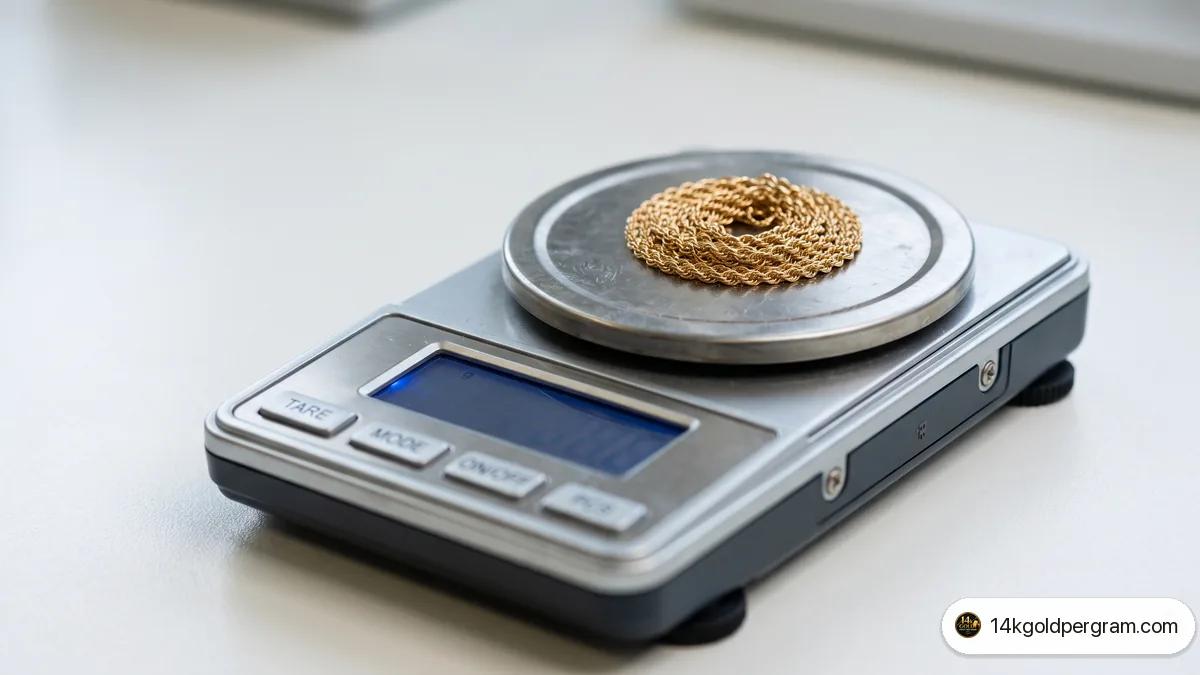
14k gold is 58.3% pure gold by weight. One gram of 14k contains 0.583 grams of fine gold. The other 0.417 grams is alloy: usually copper, silver and zinc, sometimes nickel or palladium.
That single multiplier is all you need to price any piece of 14k. Everything below is that number applied to the units you are actually likely to be quoted in.
The arithmetic, once
Karat is a fraction out of 24. Fourteen parts gold in twenty four parts total is 14 ÷ 24 = 0.58333.
To find the fine gold in any weight of 14k:
fine gold = total weight × 0.583So 8.4 grams of 14k contains 8.4 × 0.583 = 4.9 grams of fine gold. To find what that is worth, multiply the fine gold by the spot price per gram. The live calculator does both steps and shows what a buyer would actually pay on top.
Fine gold content by weight
| 14k weight | Fine gold content |
|---|---|
| 1 g | 0.583 g |
| 2 g | 1.166 g |
| 3 g | 1.749 g |
| 5 g | 2.915 g |
| 10 g | 5.830 g |
| 20 g | 11.660 g |
| 50 g | 29.150 g |
| 100 g | 58.300 g |
| 1 dwt (1.555 g) | 0.907 g |
| 1 troy oz (31.103 g) | 18.133 g |
| 1 kg | 583.0 g |
For live values against today’s market rather than gold content alone, the weight table prices every common jewellery weight, and there are dedicated pages for pennyweight, troy ounce and kilo.
Why you see both 58.3% and 585
These are not in conflict, and the difference is worth understanding because it appears on your jewellery.
58.3% is the honest karat fraction: 14 ÷ 24 = 58.33%.
585 is a hallmarking standard meaning 585 parts per thousand, or 58.5%. Assay offices set the stamp marginally above the fraction so that manufacturing tolerance cannot push a piece below the purity it claims. A bar stamped 585 must contain at least 58.5% gold.
The practical effect is nil. On ten grams the difference between 58.3% and 58.5% is 0.02 grams of gold, worth a few cents. Use 0.583 and you will never be meaningfully wrong. There is more on the stamps themselves in what 585 means on gold.
How 14k compares
| Karat | Fraction | Gold by weight | Fine gold per gram |
|---|---|---|---|
| 24k | 24/24 | 99.9% | 0.999 g |
| 22k | 22/24 | 91.7% | 0.917 g |
| 18k | 18/24 | 75.0% | 0.750 g |
| 14k | 14/24 | 58.3% | 0.583 g |
| 10k | 10/24 | 41.7% | 0.417 g |
| 9k | 9/24 | 37.5% | 0.375 g |
An 18k piece contains 28.6% more gold than the same weight in 14k, so it is worth about 28.6% more as metal. That ratio holds at any spot price, which is why the karat comparison table works as a fixed reference rather than something that needs updating with the market.
Two mistakes that cost real money
Weighing stones as gold. You are paid for metal. A six gram ring with a decent stone might be four grams of gold. Buyers deduct stone weight, and they are right to. Estimate it before you go in.
Weighing mixed karats together. A 10k chain and an 18k pendant on the scale together give a number that is wrong for both, and a buyer pricing the lot will price it at the lower purity. Separate by stamp, weigh each group, and convert each with its own multiplier.
Clasps, spring bars and pins are usually the same karat as the piece and do count. Watch movements, leather and elastic do not.
What the gold content is worth
Fine gold content is not the same as what you will be paid. Melt value is the metal; the offer is a percentage of it. A refiner pays 90 to 95%, a high street gold buyer 70 to 85%, and a pawn shop 50 to 70%. The scrap page shows all three bands against the current price, and what a pawn shop actually pays covers how to judge a specific offer.
If you are checking whether your piece is solid 14k at all rather than plated or filled, is 14k gold real gold explains how to read the stamp.