
Hallmarks
What Does 585 Mean on Gold?
585 stamped on gold means 585 parts per thousand pure gold, which is 14 karat. Here is how to read it, the other stamps you will see, and which ones mean your piece is not solid gold.
14k Gold Per Gram,
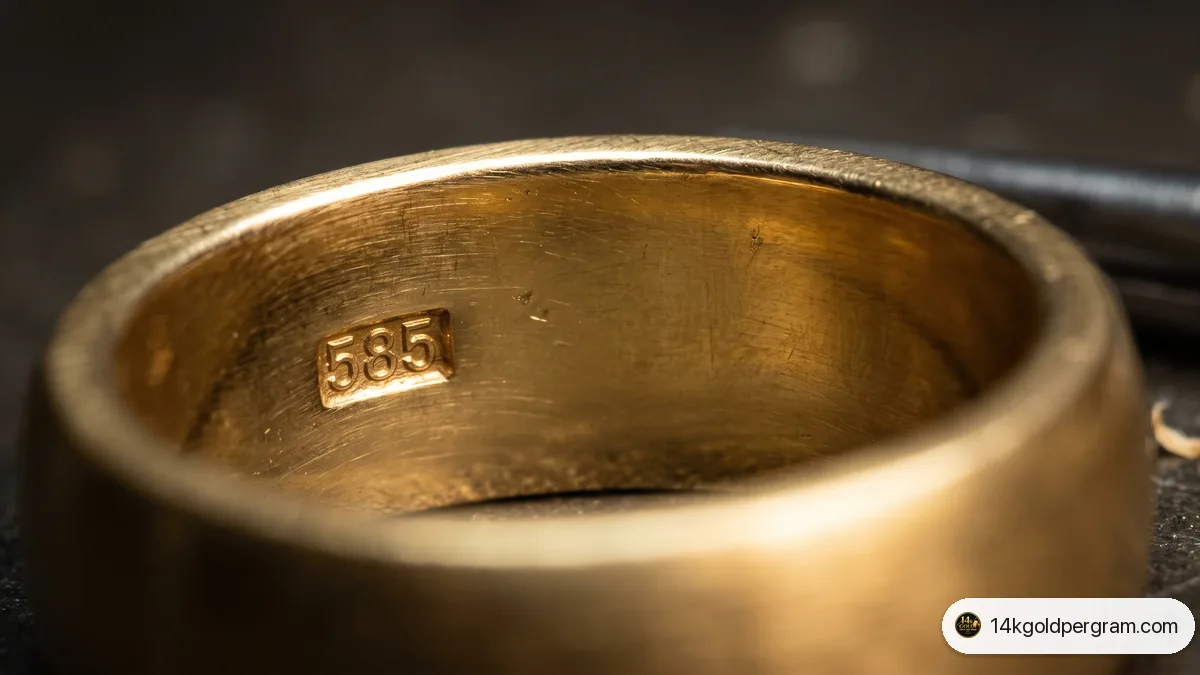
585 stamped on gold means the piece is 585 parts per thousand pure gold, which is 58.5%, which is 14 karat. It is the European convention for marking purity, and it is the same metal as a piece stamped 14K.
If you have just found this stamp inside a ring, the short version is: it is solid gold, it is worth real money by weight, and you can price it in about a minute with the live 14k calculator.
Why Europe uses numbers and America uses karats
Both systems describe the same thing from different directions.
The karat system is a fraction out of 24. 14k means 14 parts gold in 24, or 58.33%.
The millesimal system states parts per thousand directly. 585 means 585 in 1,000.
The numbers differ slightly, 58.33% against 58.5%, because a hallmark is a floor rather than an average. An assay office sets the stamp just above the karat fraction so manufacturing tolerance cannot let a piece fall below what it claims. On ten grams that difference is 0.02 grams of gold. It will never change a transaction.
Every purity stamp you are likely to see
| Millesimal | Karat | Gold content |
|---|---|---|
| 999 or 9999 | 24k | 99.9% |
| 916 or 917 | 22k | 91.7% |
| 750 | 18k | 75.0% |
| 585 or 583 | 14k | 58.3% |
| 417 or 416 | 10k | 41.7% |
| 375 | 9k | 37.5% |
| 333 | 8k | 33.3% |
583 and 585 both mean 14k. Older American pieces often use 583 because it rounds the true fraction down rather than up. Same metal, same value.
The karat price table shows what each of these is worth per gram against the live market.
The stamps that mean it is not solid gold
This is the part worth reading carefully, because it is where the money is.
A number or letters attached to the karat mark usually means the gold is a coating, not the substance.
- 1/20 14K GF or 14K GF — gold filled. A thick gold layer bonded to a base metal core, typically 5% gold by weight. The fraction tells you the proportion. It has some recoverable value but many refiners will not take small amounts. See the gold filled page.
- 14K GP, GEP, HGE — gold plated, gold electroplated, heavy gold electroplate. A coating microns thick over brass or steel. Gold content is a fraction of a percent. Worth nothing as scrap.
- 14K RGP — rolled gold plate. Thicker than plating, thinner than filled. Still not scrap material.
- 925 — sterling silver, not gold. Sometimes gold plated on top, which is vermeil.
- PLAT or 950 — platinum.
A piece stamped only 585 or only 14K, with no fraction before it and no letters after it, is solid throughout.
Other marks on the same piece
A single item often carries several stamps, and only one of them is the purity.
A maker’s mark is initials or a small logo identifying the manufacturer. It says nothing about purity.
“Italy” next to 585 means it was made in Italy, which has a long tradition of gold chain manufacturing. It does not indicate higher purity, though the workmanship is often good. 14k Italy is 14k.
An assay office mark is a small pictorial stamp used in countries with compulsory hallmarking, such as the UK. If present it means an independent body verified the purity, which is a genuine assurance.
A date letter appears in UK hallmarking and indicates the year of assay.
What if there is no stamp at all?
Plenty of genuine gold is unmarked: older pieces, handmade work, items where the stamp has worn off a thin band, and jewellery from countries without compulsory hallmarking.
Unmarked does not mean fake, and it does not mean solid either. Any buyer will test it rather than guess, usually with an acid scratch test or an XRF analyser. XRF is non-destructive and accurate, and most established gold buyers have one. Ask them to show you the reading; a reputable buyer will.
Do not sand a piece to look for base metal underneath unless you have already decided to scrap it.
What 585 gold is worth
585 gold contains 0.585 grams of fine gold per gram of metal. Multiply by the spot price per gram and you have melt value. At a spot price around $4,400 per troy ounce that is roughly $82 per gram of 585 gold.
Melt value is not the offer. What you will actually be paid is a percentage of it:
- Refinery: 90 to 95%, bulk lots only
- Gold buyer: 70 to 85%
- Pawn shop: 50 to 70%
The scrap value page shows those bands against today’s price, and what a pawn shop actually pays explains what moves a specific offer.
For the full purity breakdown and conversion tables, how much gold is in 14k has the numbers for every common weight.