
Selling gold
14k Gold Price Per Gram at a Pawn Shop: What They Really Pay
A pawn shop pays 50 to 70% of melt for 14k gold, not the price per gram you looked up. Here is the gap, what other buyers pay, and how to spot a fair offer.
14k Gold Per Gram,
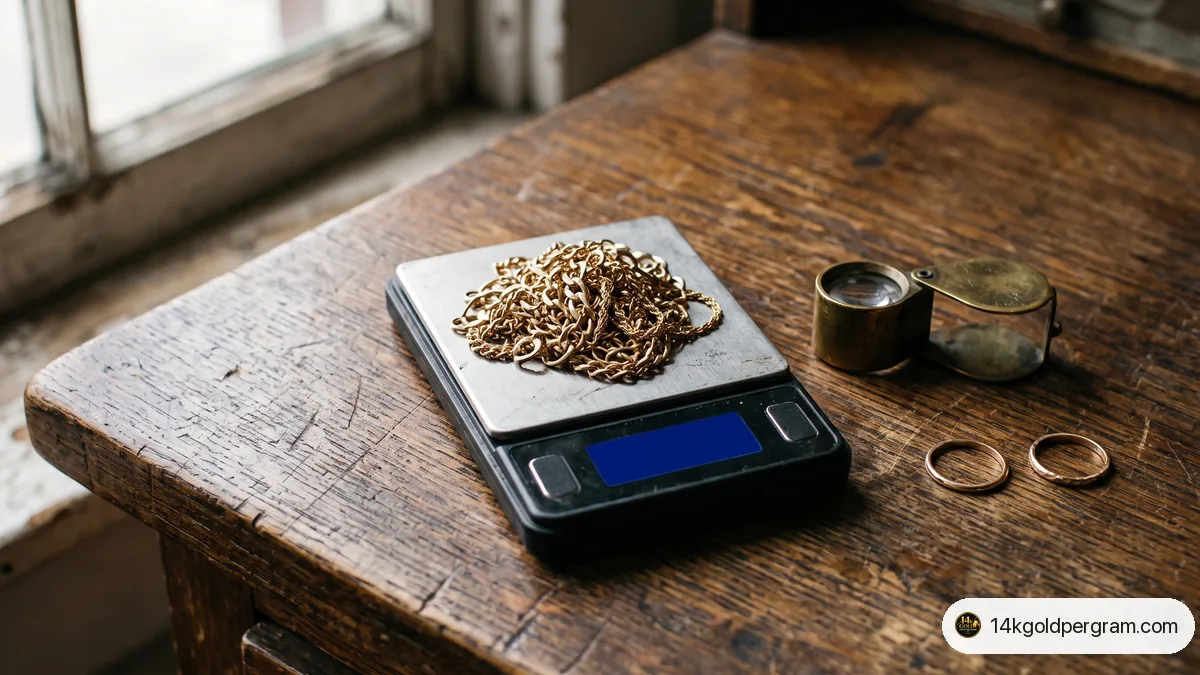
A pawn shop will usually offer you 50 to 70% of what your 14k gold is worth as metal. On five grams of 14k at a spot price of $4,400 per troy ounce, the melt value is roughly $118, so expect an offer somewhere between $59 and $83. A dedicated gold buyer would offer $83 to $100 for the same five grams.
That gap is not a scam. It is the price of walking in without an appointment and walking out with cash. Whether it is worth paying is the actual question, and it depends on numbers you can work out before you go.
Work out the melt value first
Every negotiation you have at a counter is a negotiation about a percentage of one number. If you do not know that number, you are not negotiating.
Melt value for 14k is simpler than it sounds. 14k gold is 58.3% pure, so a gram of it contains 0.583 grams of fine gold. Multiply that by the current spot price per gram and you have the metal value. The live 14k price per gram does this for you, and the scrap value page shows the payout ranges for each buyer type against today’s market.
Two things to get right before you weigh anything:
- Weigh to a tenth of a gram. A kitchen scale reading in whole grams is not good enough. At current prices a tenth of a gram of 14k is worth about the same as a coffee, so rounding 4.7 grams up to 5 changes the answer by real money.
- Take the stones off the scale. You are paid for metal. A six gram ring with a decent stone might only be four grams of gold. The buyer will deduct stone weight and they are right to. Estimate it yourself first or you will think you are being cheated when you are not.
What each buyer pays, and why
| Buyer | Typical payout | Why |
|---|---|---|
| Refinery | 90–95% | Buys in bulk, melts in house, no retail overhead. Rarely deals with individuals. |
| Gold buyer | 70–85% | Metal is the whole business. Competes on price because that is all it sells. |
| Pawn shop | 50–70% | Metal is a sideline. Prices in the cost of holding it until a lot is worth refining. |
The pattern is consistent across markets: the further a buyer is from the refinery, the more of the spread they keep. A pawn shop sits furthest away. It has to buy your chain, put it in a safe, insure it, and wait until it has enough weight to be worth a refiner’s attention. That waiting has a cost, and you pay it.
The four things that move a pawn shop offer
A written quote from somewhere else. This is the only lever that reliably works. Get one mail-in or high street quote in writing, bring it, and the counter offer usually moves. Without it you are arguing about a number neither of you has named.
Weight, not sentiment. Nothing about the piece’s history changes the metal. A pawn shop paying scrap rates is not buying a wedding ring, it is buying 4.3 grams of alloy. Arguments that begin with what you paid for it go nowhere.
Which unit they quote in. Many US buyers quote per pennyweight rather than per gram. A pennyweight is 1.555 grams, so a price quoted per dwt looks about 55% more generous than the same price per gram. Convert everything to one unit before you compare. The pennyweight page has the arithmetic.
Separating your karats. A 10k chain weighed together with an 18k pendant gives a number that is wrong for both, and the shop will price the mixed lot at the lower purity. Weigh each karat separately. The price by karat table shows what each is worth per gram.
When a pawn shop is genuinely the right choice
There is an honest case for taking 60%. If you need money today, a pawn shop is often the only buyer open and paying on the spot. Mail-in services take a week and hold your gold while they decide. A gold buyer may not be within driving distance.
There is also the pawn option proper. A loan against the gold rather than a sale keeps the piece, and if you can repay it you have not sold a ring you wanted to keep at 60% of its metal value. Interest rates on those loans are high, so run the numbers, but for something you actually care about it is usually the better of the two doors.
What to do before you walk in
- Weigh each piece separately, to 0.01 g if you can.
- Note the karat stamp on each: 585 and 14K are the same thing.
- Work out melt value with the calculator, then the 50–70% and 70–85% bands.
- Get one written quote from a mail-in buyer or a second shop.
- Decide your walk-away number before you leave the house, and hold it.
An offer inside the 50 to 70% band from a pawn shop is normal. Below 50% is poor and worth walking away from. Above 70% from a pawn shop is a good day, and you should take it.
If you want to see how the underlying metal price has moved before you decide whether to sell now or wait, the price history plots the closes we record ourselves, one a day.