
Gold care
How to Clean Gold Jewellery Without Damaging It
The right method depends entirely on whether your piece is solid, plated or vermeil. Scrubbing plated gold removes the gold. Here is what is safe for what.
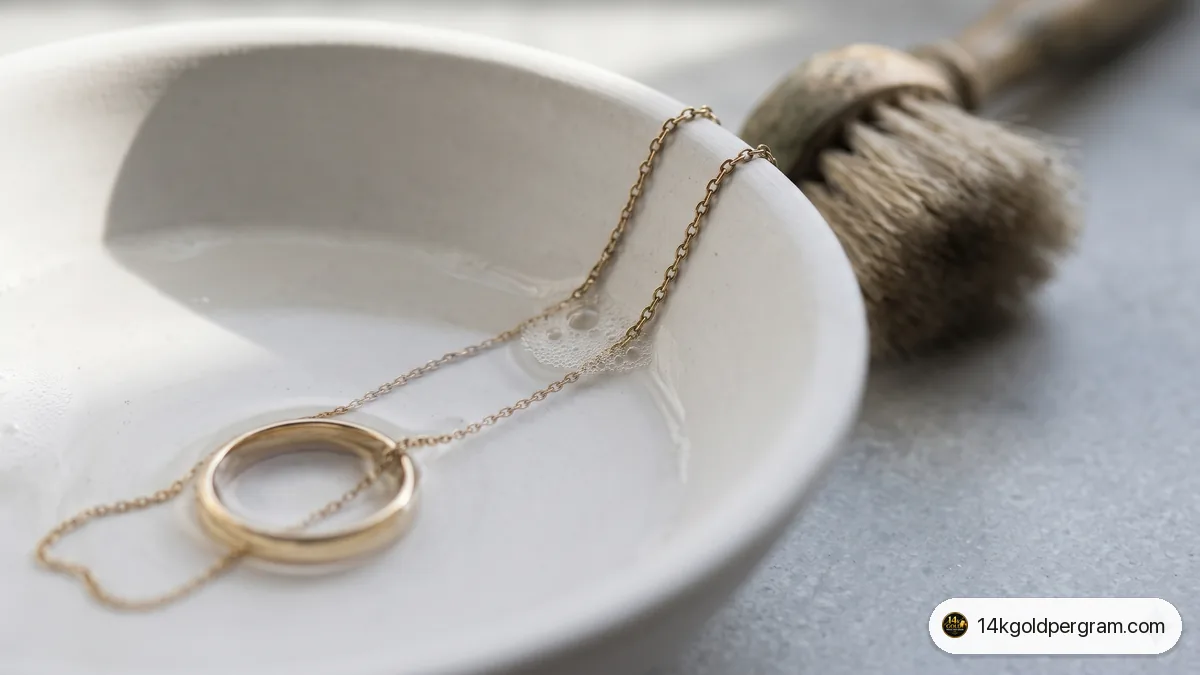
The single most useful thing to know about cleaning gold jewellery is that the right method depends entirely on what you are holding — and almost no cleaning guide says so.
Generic advice to soak it and scrub it with a soft brush is good advice for solid gold. Applied to a gold plated chain, it will take the gold off. The plating is a few microns thick, and a toothbrush is more than capable of removing it.
So before any method, establish which of three things you have.
First, work out what you are cleaning
Solid gold is stamped 10K, 14K, 18K, 585, 750 or similar with no qualifier. The gold runs all the way through. It is durable and forgiving, and almost any gentle method is safe.
Gold plated is stamped GP, GEP, HGE or RGP. Microns of gold over brass. Treat it as a surface you can destroy, because it is. Our page on what gold plated is actually worth covers how thin that layer really is.
Gold vermeil is stamped 925 with a gold finish — plating over sterling silver. Same fragility as plating, with the added complication that the silver beneath tarnishes properly and the usual silver remedies will strip the gold off the top.
If there is no stamp, our guide to testing gold at home covers how to work out which you have before you commit to a method.
Cleaning solid gold
This handles the great majority of everyday dullness, which is skin oil, soap residue and cosmetics rather than anything dramatic.
- Warm water, not hot. A bowl, with a few drops of plain washing-up liquid.
- Soak for ten minutes. This does most of the work, and patience here means less scrubbing later.
- Work gently with a soft toothbrush. Pay attention to the back of a ring band, behind stone settings and the underside of chain links, which is where grime collects and where a cloth never reaches.
- Rinse thoroughly in clean water. Residual soap dries to a film and you will be back where you started.
- Dry completely with a soft lint-free cloth, then leave it out for a few minutes before storing. Trapped moisture accelerates the discolouration of the alloy metals that our post on whether 10k gold tarnishes explains.
Put a sieve or a closed plug in the sink before you start. This is not a joke about jewellery down the drain; it is the most common way people lose a ring.
For stubborn dullness on plain gold, a jeweller’s polishing cloth is impregnated with a mild compound and is the right tool. Use it on solid gold only.
Cleaning plated and vermeil
Different rules, and they are mostly rules about what not to do.
Wipe, do not scrub. A soft dry cloth, or at most a barely damp one followed immediately by drying. No brush, no polishing cloth, no abrasive of any kind — a polishing cloth removes a microscopic layer of metal, which is exactly what you cannot spare.
No ultrasonic cleaner, ever. The cavitation that lifts grime out of a setting also attacks the bond between plating and base metal.
No silver dip on vermeil. This is the specific trap. A vermeil piece that looks tarnished sends people to silver cleaner, and silver dip is a chemical stripper that will take the gold layer with the tarnish and leave you holding a silver chain.
Accept that plating is consumable. Even perfectly treated, it wears through where a piece rubs, and the honest answer is that cleaning cannot restore it — only replating can.
What stones change
Metal is the easy part. Stones set the limits.
Hard and safe: diamonds, sapphires and rubies tolerate soap, water and a soft brush without complaint.
Needs care: emeralds are routinely oil-treated and hot water or ultrasonics strip the oil, making inclusions far more visible. Opals contain water and crack with thermal shock or prolonged soaking. Pearls are soft, porous and surface-coated — wipe with a damp cloth only, never soak. Turquoise, amber and coral are all porous and all unhappy in a soak.
Glued, not set: a lot of costume and some fine jewellery holds stones with adhesive rather than prongs. Soaking dissolves the glue. If a stone sits in a cup with no visible prongs or bezel, assume glue and keep it dry.
When you cannot identify a stone, wipe rather than soak. The GIA publishes identification material if you want to know what you have.
Things not to use
Toothpaste. It is abrasive by design, formulated against tooth enamel, which is far harder than gold. It will dull a polished surface with fine scratches while removing a film that soap lifts anyway.
Baking soda. Same objection. Mildly abrasive, and the aluminium-foil-and-bicarb trick circulating online is a silver tarnish reaction that does nothing useful for gold and will damage plating.
Bleach and chlorine. Actively destructive. Chlorine attacks the copper, nickel and zinc in gold alloy and can cause solder joints to fail outright. This is the real reason to take gold off before a swimming pool — not the water, the chlorine.
Ammonia on anything delicate. Fine on plain solid gold in dilute form, bad for pearls, opals and treated stones.
How often, and when to stop
A monthly clean for daily-worn pieces and a wipe after heavy use is plenty. Over-cleaning is a real thing: every polish removes a little metal, and a ring polished repeatedly over decades measurably thins.
Take it to a jeweller instead when a stone moves or rattles, when prongs look thin or flattened, when a chain has a kink or a stretched link, or when a vermeil or plated piece has worn through. Most jewellers clean and check settings free, and a loose stone found at a counter is cheaper than one found missing.
If you are selling, skip all of this
Worth stating because it saves people an afternoon. A gold buyer pays on weight and purity and nothing else, and the piece is going to be melted. Surface condition is irrelevant to the offer.
If a discoloured chain is what prompted this, the thing that matters is what it weighs and what karat it is — our weight calculator gives the live figure, and what a pawn shop actually pays covers the gap between that and an offer. Clean it because you want to wear it, not because you think it will fetch more.