
Gold care
Does 10k Gold Tarnish? Settling the Contradiction
10k gold does not tarnish the way silver does, but it does discolour. The copper in it oxidises. Here is what actually happens, how fast, and how to reverse it.
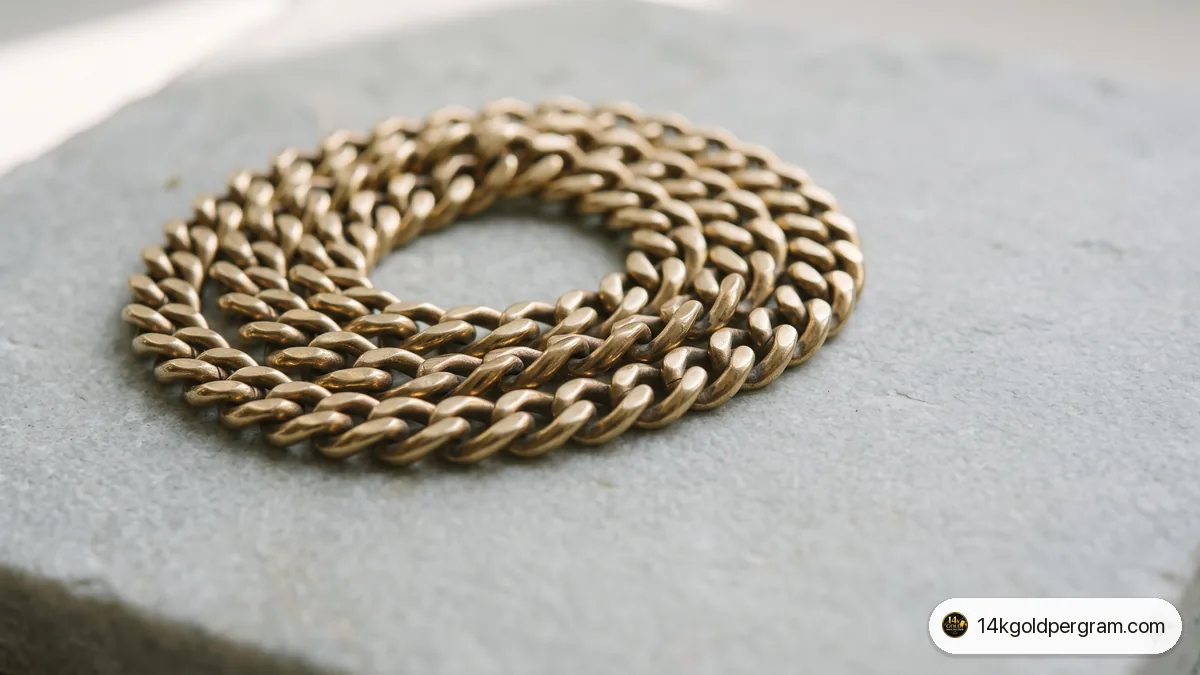
10k gold does not tarnish in the strict sense of the word, but it does discolour — and the people arguing about this are not disagreeing about chemistry, they are disagreeing about vocabulary.
Search this question and you get flat contradictions from sources that all sound confident. One jeweller’s guide says 10k is “fully tarnish-resistant.” Another says “10K gold does not tarnish!” with an exclamation mark. A third says it “may tarnish over time.” A fourth says it “will eventually tarnish and fade.”
They are describing the same metal. Here is what is actually happening.
Tarnish means something specific
Tarnish, used precisely, is a layer of sulfide or oxide that forms on a metal surface and dulls it. Silver tarnishes famously: silver sulfide, black, and it comes back however often you polish it.
Gold does not do this. Gold is chemically noble — it does not react with oxygen or with the sulfur compounds in air, which is why gold recovered from shipwrecks comes up bright after centuries underwater. That part is not marketing, it is the reason gold has been used for ornament for six thousand years.
So anyone who tells you gold does not tarnish is right. The trouble is that 10k gold is only 41.7% gold.
The other 58.3% is the part that reacts
10k is the lowest purity the United States permits to be sold as gold. Fourteen of its twenty-four parts are other metals — typically copper, with zinc, silver and sometimes nickel. Our 10k gold price page covers what that purity means for value; here what matters is that copper is reactive.
Copper oxidises in air. It reacts with the acids and salts in sweat. It darkens, and on skin it can leave a green mark. None of this touches the gold, which is why a discoloured 10k ring has exactly the same melt value as a bright one. But the piece in your hand looks different, and “my ring went dark” is a real observation, not a misunderstanding.
That is the whole contradiction. The gold does not tarnish. The alloy around it does. Both camps are half right and talking past each other.
How the karats compare
The proportion of reactive metal is the entire story, and it scales exactly with purity:
| Karat | Gold | Alloy | Relative tendency to discolour |
|---|---|---|---|
| 10k | 41.7% | 58.3% | Most |
| 14k | 58.3% | 41.7% | Moderate |
| 18k | 75% | 25% | Least |
| 24k | 99.9% | ~0% | Effectively none |
10k carries roughly 40% more alloy than 14k, so it discolours sooner and more visibly. If you want the value comparison alongside the wear one, our 14k vs 18k page sets those two side by side, and the karat comparison covers all six purities.
The International Gem Society has more detail on what goes into each alloy and why.
How fast, and what speeds it up
There is no fixed timetable, because the variable that matters most is you. Two people can wear identical 10k chains and one will dull in four months while the other stays bright for four years.
What accelerates it:
- Sweat, which is acidic and salty, and varies a lot between people
- Chlorine, which is the worst of the common exposures — take 10k off before a pool
- Salt water
- Cosmetics, sunscreen, hairspray and perfume, applied over jewellery
- Household cleaners, especially anything with bleach or ammonia
What does not matter much: plain water, ordinary air, or storing it in a drawer. A piece in a box will sit happily for years.
The pattern of discolouration is a giveaway too. It shows first where the piece rubs and where sweat collects — the back of a ring band, the inside of a clasp, the links on the underside of a chain. Even discolouration across a whole piece usually means a chemical exposure rather than wear.
Reversing it takes about five minutes
Because this is a surface effect on the alloy, it comes off:
- Warm water and a few drops of mild washing-up liquid.
- Soak for ten minutes.
- Work gently with a soft toothbrush, paying attention to the back of the band and inside the links.
- Rinse thoroughly and dry with a soft cloth.
- For anything stubborn, a jeweller’s polishing cloth. These are a few pounds or dollars and last for years.
Skip the ultrasonic cleaner if the piece has stones, especially emeralds, opals or anything glued rather than set. And skip the home remedies involving toothpaste or baking soda — both are abrasive enough to put fine scratches into a soft metal to remove a film that soap would have lifted.
Does any of this affect what it is worth?
No. This is worth stating plainly because it is the question underneath the question for a lot of people.
A gold buyer pays on weight and purity. Discolouration is a film on the surface, it weighs nothing, and it burns off in refining. A tarnished 10k chain and a gleaming one of the same weight fetch exactly the same price, and polishing before you sell adds nothing to the offer.
If you want the actual figure for what you are holding, the weight calculator prices it live.
So should you avoid 10k?
Not necessarily, and this is where the jewellers who say “10k does not tarnish” are being more reasonable than they sound. In exchange for the discolouration you get a harder, more scratch-resistant metal that survives daily wear better than 14k or 18k — which is exactly why class rings, work bands and hard-worn chains are so often 10k.
The trade is real in both directions. If you wear a piece every day and want it to keep its shape, 10k is a sensible choice and the occasional clean is the cost. If you want something that stays bright with no attention and you are not knocking it about, go higher. Our post on whether 14k counts as real gold covers the same trade one step up the scale.
What nobody should tell you is that discolouration means your gold is fake. It does not. It means it is an alloy, which all wearable gold is.